Good News: Now MiGiC Poly CAN detect individual strings on a standard guitar without a HEX pickup. Will MG3 Standard make this game-changer in the future?

anjo has been quite clear that the cost is the driving factor.

it appears that his position is that jamo should invest tens of thousands of dollars developing this technology so that it can be included in mg3 standard for free.

so unless you’re willing to sell him your optical system for < $100 you aren’t going to make him happy.

thank you. it’s clear that when they say ‘string detection’ what they actually mean is polyphony.

anyway, now i understand the source of this annoyance.

1 Like

Not trying to be difficult here, but it does not state “string detection”, but “per-string detection”, which is very clearly indicating that it should be able to detect all the strings individually - which it is clearly not doing as multiple users here have tested the program and not been able to get anything close to hex level performance. So this is marketing hype for now.

Setting aside the obvious economic cannibalization of creating such a solution in MIDI Guitar 3 on MIDI Guitar HEX, I would be very interested in hearing your thought @JamO on the technical feasibility of such a hypothetical “no additional hardware required” solution for picking up hex signals - if you don’t mind!

I’ve experimented with this in the past. I guess almost 10 years ago, so I need to revisit it at some point.

Assuming an on-device training system built on top of MG, where it learns the actual attacks of your strings and playing style, I think it may be doable, but with some penalty in latency and some notes will end up on the wrong string anyway.

While that would be an exciting feature for “auto-scoring” and interactive music applications, I think for MIDI Guitar - playing different instruments on different strings - is sort of a minor thing? Maybe im old fashioned, but to me this doesnt really add that much value. Hex is something that makes tracking a lot better - that’s its real value.

Just for completion: the pitch filter actually works, and I know it’s a far cry from string detection - but it can be useful to split bass and highs.

2 Likes

Got it - thanks for the input! Then @anjo I don’t think we should expect a hardware free solution for Hex.

Pragmatism is needed! Agree 100%.

Hi @Vaultnaemsae, before I reply to @JamO here, I wanted to first thank you for your factual and constructive posts on the forum—as you’ve done again now—which are always very refreshing. :slightly_smiling_face: That’s also my preferred way of clarifying things, which is what I’ll do in a new thread on this topic.

Your proposed setup with optical sensors or video could be useful for testing and training purposes, but probably not for the practical, long-term use of the MG3 Standard on standard electric guitars, which are mostly passive.

Another option for testing and training purposes would be to use the Hex pickup and a standard magnetic pickup in parallel on the same guitar at the same time.

The Hex pickup could clearly and immediately identify the string and the note played on it, while the magnetic pickup simultaneously delivers its mono signal and, together with the Hex signal, trains the single-string recognition system for MG3 Standard.

you could have had the decency to wait until mg3 is formally released and the manual complete before dragging us back into your fantasy.

uncool.

Hi guys, Philip here. I did not mean to trick anyone, I have changed the wording on the webpage to make it clear that it does per note detection, current 0.18 does not tell you what string the note belongs to, which will come in a future release however. Just wanted to set the record straight. You are all of course welcome to test and evaluate MiGiC if you like, Im a one man operation and this is the verify first early access release, never meant to harm/mislead anyone. @Dutti67 Sorry that you had some rough experience with the input gain, I am working on some automatic gain staging as well. Anyways, don’t want to hijack this thread, just set the record straight :slight_smile: Wish you all good luck with the guitar to MIDI playing!
2 Likes

Thanks for chiming in! And good luck on the per-string development - fingers crossed that you’ll be able to pull it off :crossed_fingers:

1 Like

Thank you very much, I usually dont chime in but reading the title felt a bit hostile, anyways I could see the confusion and I have changed the wording. Will make an announcement when I make it. Cheers

2 Likes

Hi @JamO, a lot has happened in this field over the past 10 years, so it’s definitely worth taking another look.

I’d like to start by responding to your post here specifically regarding the autoscoring feature of the new MG3 Standard with single-string detection.
I’ll have more to say later about other innovative ways to use this new MG3 Standard in live performances, as well as some thoughts on its technical feasibility.

Teachers at local music schools have repeatedly told me that autoscoring software is often used successfully in keyboard lessons and by students at home. In contrast, existing autoscoring solutions for guitar, such as Yousician or the Gibson app, are not as effective and are rarely used by students.

With perfect autoscoring — including for guitar — the student immediately connects what they see (the sheet music) with the physical action (pressing a string) and the result (the sound). This triple anchoring in the brain through the eyes, ears, and muscles significantly accelerates the learning process compared to pure memorization.
If the guitar’s tones is recognized without any perceived delay, even faster pieces or rhythm exercises—where milliseconds matter—go well. Through a precise evaluation of touch dynamics, the student simultaneously learns the correct dynamics.

For example, through a seamless integration into guitar lessons, students could be introduced to MG3 Standard single-string detection for the first time via their guitar teacher (who acts as a product ambassador in this context)—something neither of them might otherwise have discovered on their own.

This represents a market potential of millions of young people—the generation of the future. While they often have little money in their pockets, they could likely still afford the new MG3 Standard.
Do you really want to miss out on this huge market opportunity for the new MG3 Standard, made possible solely by the “door-opener” of the new, attractive autoscoring feature?

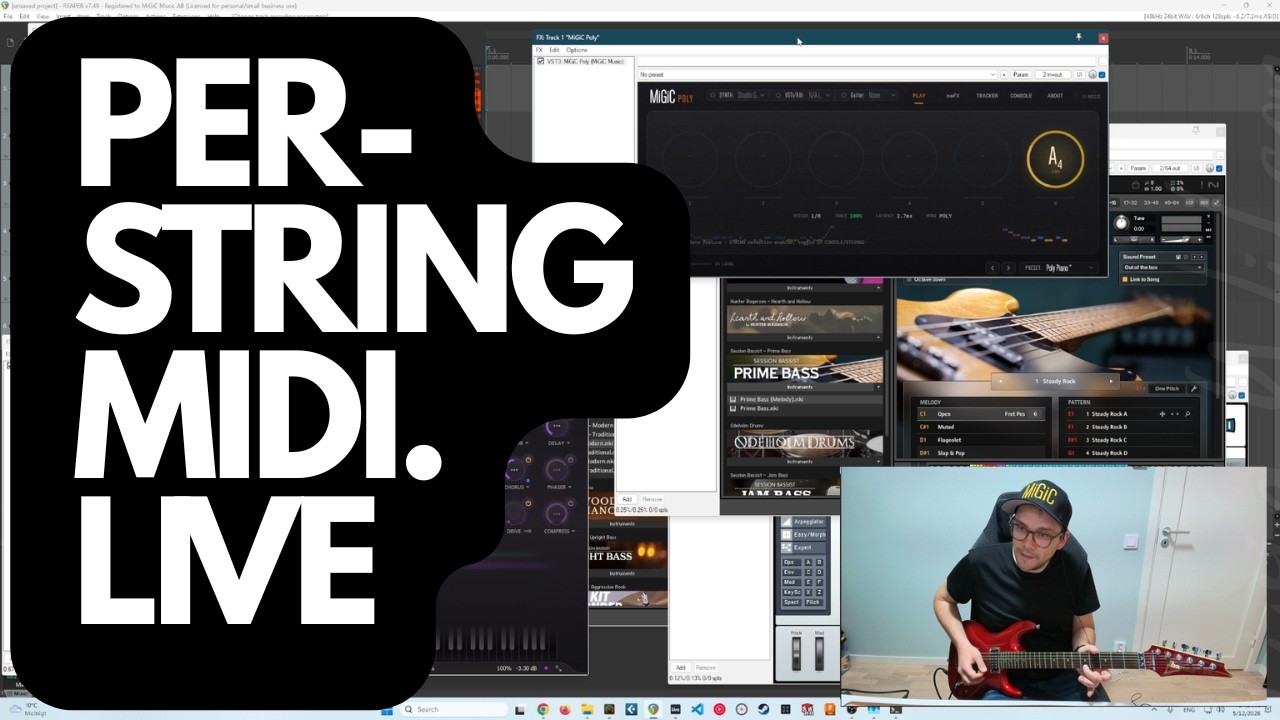
Hey everyone — wanted to circle back on this thread now that I’ve shipped per-string detection on standard pickups. Full live demo here:

The discussion in this thread genuinely shaped what I prioritized, so thanks for the pressure. The criticism was fair at the time it was made — MiGiC Poly didn’t do per-string on a standard pickup back then. It does now.

It’s still beta and not perfect — the failure modes peterharket described (dense voicings, repeated notes across strings) are still the hardest case and I’m working on it. But the core capability is real and working in real sessions.

Public beta opens next week. Happy to set anyone here up with early access — drop me a line at my info mail from my webpage.

Feedback welcome, especially the critical kind.

@anjo @peterharket

4 Likes

Damn, that was quick!

I’d be very interested in a beta license. I’ll send you a private message.

Thanks for doubling down on this!

Sure thing! The code is compiling as we speak :slight_smile:

1 Like

Congratulations! That looks impressive.

5 Likes

Thanks, you can probably tell from the video I’m a bit worn out — found this thread Sunday night and pulled a couple of all-nighters. What you’re seeing is literally the first signs of life of the tracker, so the fact that it holds up at all in a real session is honestly a relief. Long road ahead.

I’ll admit some of the earlier comments did sting.

Mostly though, it’s a small field and there are only a handful of us actually building in it. We all benefit when the tone stays constructive. Your work with MG3 set a bar that pushed me, and I hope MiGiC Poly pushes back in some way that’s useful to you too.

4 Likes

Good thing you weren’t scared away - this is actually a really friendly forum. I guess the pushback was on the stated “per-string detection” which at the time was not true. We are all very grateful that a handful of passionate developers go out of their way to develop something that we all benefit from, so I think I speak for all of us that no harm was intended!

2 Likes