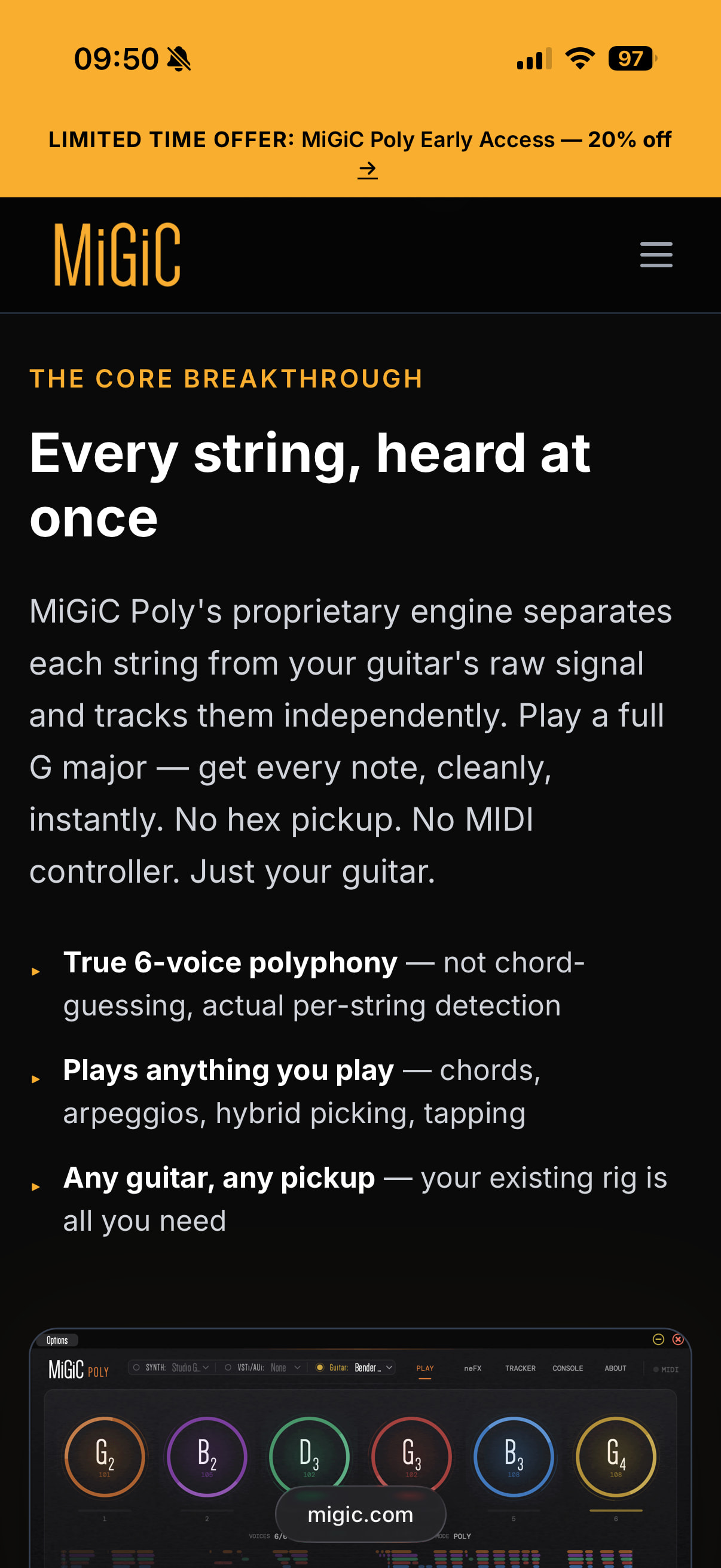
MiGiC has recently started offering single-string detection for standard magnetic guitar pickups without HEX hardware. Has anyone tested this thoroughly yet?
This has been my suggestion for a long time, but the community has only responded with astonishment, head-shaking, or even outright rejection.
Interesting! I just downloaded the Demo version and did a short test of the poly tracker on my laptop. In my case it lacks detection of notes at all, not just from which string they are coming. There is not much that can be adjusted in order to raise the gain (or I haven’t found it yet), my little iRig interface is maxed out. I have an input signal level of approximately 60% (UI: “In Level”) but it’s only picking up roughly 30% of the notes I play. Need to check it on my studio computer.
This is super interesting. As someone who’s been on the fence with HEX due to the high hardware cost, this could perhaps be the silver bullet! Will definitely check this out.
Sorry, this software has nothing to do with single string detection, just polyphonic mode. It offers nothing what MG3 couldn’t do, and MG3 does it better and has much more features.
Let’s not inflate the field of MIDI Guitars with sensational and untrue claims: There are more than enough hurdles already (latency, lack of sensitivity, accuracy and feeling of disconnect) for a new guitarist to pick up any kind of MIDI system. Claims like these can make a bad first impression and hurt all of us.
why wouldn’t you try it yourself before sharing? then there would be no need for the click-baity ‘fake or not’.
as a courtesy to the others here, ten minutes of your time would have allowed you to say ‘FAKE!’
lastly, exactly where does migic say they offer ‘single string detection’? and does that mean what you want it to mean?
you’d make a stronger case for your obsession if you would provide specific code to support your claim that this type of note detection is feasible with acceptable latency and accuracy.
Please check it out and you will see that it’s not true what they state. They also talk about “no MIDI pickups required” and such things does not exist.
No matter what string you play first, the first of the six indicators will show the note (if it is detected at all). Second note will be the second indicator, and so on…..
This is in best case polyphonic detection. Try pitch bend with a VST. I couldn’t manage to bend smoothly, it’s taking seminote jumps. Try a polyphonic bend → everything “jumps”….
Got it - for my use case, just getting 100% tracking of complex harmonies would suffice (i.e. I don’t need pitch bend etc). But I’ll test and report my findings
Managed to sneak in some “me time”. Unfortunately the MiGiC software fares no better than the vanilla MIDI Guitar 3 when it comes to tracking of complex chords. Once I introduce minor seconds, chords with repeated notes (one played on fifth string, followed by an open string), and generally hexad chords (i.e. chords played on all strings), things go awry. Thus, I’m still waiting for someone to offer up a convenient HEX pickup with direct USB-C interface to the computer.
The dev was kind enough to allow me a license for MiGiC NX (mono version) to test it out thoroughly.
Once I figured it out, I can say that it does vanilla monophonic pitch-to-MIDI just fine, you might even say well…but, only monophonic.
I installed the Poly version yesterday. Nice GUI and I like the effects and amp profiles, But, the evaluation time interruption is too short for me not to want to rip my hair out.
Once you eventually figure it out, it will track. But I think that calling it “Poly” is a bit misleading at this stage. And keep in mind that it will only work on a +/-2 semitone range for pitchbend, at least for VSTs/external synths.
@JamO, well, I totally understand what you’re saying.
In response to my email inquiry, the MiGiC developer personally confirmed that it doesn’t currently support single-string detection, but plans to in the future.
In this regard, their websites are misleading and just marketing hype.
But regardless of that: @JamO: It’s your great mission „No need for inconvenient special pickups and no physical mods“ to free guitarists from all this HEX hardware.
A huge step in that direction has undoubtedly already been very successfully achieved with the MG3 Standard.
And single-string detection for the MG3 Standard would mean complete freedom from any HEX hardware.
Setting aside MiGiC’s marketing hype and comes across as very misleading, there is a very clear need among guitarists for real-time single-string detection without HEX hardware in a audio-to-MIDI software.
I am convinced that @JamO will surprise us all in the not-too-distant future with a powerful solution in MG3 Standard featuring real-time single-string detection.
Although I think @JamO it’s pure genius, we have the stone wall of physics. To separate a signal made of 6 strings in real time retaining nuances and different ‘note velocity’ is very close to impossible. Maybe quantum computers will but I think I’ll be too old. AI can help, guess and interpret but it could take your nuances away because it will depend on a training set. Especially now that MPE can do things that in the past were not possible, MG3 rises as a shining star, IMHO.
I happen to have invested in Roland/Boss GK gear so now I am left with aging equipment as a VG99 (not a good choice as no HEX output) and GP10 (HEX Output via USB) however I am not using GP10 a lot. I am using MG3 for solos and complementing with chords via MG3 when needed. In the meantime, I have also learned the basics triads and some quads on keyboard. It’s the mix of those three methods that keeps me afloat with all those VSTs. Usually I make an example of ‘In the Air Tonight’. Playing the three chords in sequence with that nuance requires a keyboard or guitar skills that I miss completely. So, for me learning keyboards, despite the existence of MG3 (which I use for chords, including pads / brassy pads) it’s a complement to my being a guitar player. MG3 freed me from using GK3 devices to play flutes, monophonic synth sounds and the like as I have shared here. My palette of sounds expanded in an imaginable way. The old JP1010 I own it’s getting dust. In the past it was triggered by VG99 (six separate MIDI Channels, no MPE) via DIN cable. Here and there I switch it on and play some patches. Today with MG3 double notes solos parts and passages are now possible and MPE can trigger a lot of changes in real-time. Chords on MG3 are welcome and when needed I must switch my GP10 on for some recordings so that I can use MG3HEX. So, in a nutshell MG3 is the highest level reachable today in the Guitar to MIDI world for solo and poly (and if you add HEX the sky’s the limit) and it’s no shame if you complement it with real keyboards sometimes to trigger VSTs that were made to be played by Keyboards.
I expect @JamO to surprise me even more with his magic in the future but I do not expect perfect single string separation from a guitar signal to happen any time soon without an HEX pickup, even if MG3 does an excellent job at it!
@pasha, thanks for your “Ode to Joy” for MG3 Standard—I can only agree
However, I’m far more optimistic about the future of MG3 Standard’s single-string detection:
There’s still a lot of potential, even though the physics of the strings will always remain the same. Even in MG3, @JamO has achieved a great deal over the years that previously seemed unthinkable to many.
A practical solution that captures all the nuances of playing will be possible in the future, primarily through the use of new neural detection methods and prediction strategies, as well as the creation of new real-time algorithms for single-string detection in MG3 Standard.
In addition, calibrating the strings of the guitar being used beforehand and during play could make a significant contribution to this, as already described in my linked post above in the opening post here.
What about an optical/video sensor that delivers string activity info? Not necessarily frequency but just movement so that incoming audio being converted to MIDI can infer the string source to more decisively transform the input signal?

 (because the HEX hardware is a major hurdle for me)