
Is anyone noticing that when using certain plug ins (Roland Zenology) the pitch is way off yet the pitch shows correctly in midi guitar on the keyboard. It’s almost like it’s down about 2 octaves and then some. Is there a setting to adjust? I don’t want to purchase the license key for hex until I know this can be fixed (could be user error) - MM
Almost all plug ins will have an Octave up and down in the setting.
Alternatively you can use the TRANSPOSER midi tool in MG3 to adjust the pitch.
Yes, but weird that it would work with some plug-ins and not others and also those same presets work with other programs like gig performer so I’m not sure what’s happening. I’ll keep digging. I was just curious if anybody else had experienced a similar problem.
FTP is of course outputting midi, received and confirmed in the host which then is routed to MG3 hex. So are you saying that essentially MG3 hex should only receive audio data? Not midi?
And for the standard MG3, I tried it stand alone with an internal instrument and still nothing. I’ll have to play around with it more I guess
MG3 generates MIDI note data from the audio stream it receives. It isn’t really a sound module though it has some characteristics of one.
It can receive CC or PC messages to control parameters or select presets.
Wouldn’t the MIDI Device be an option?
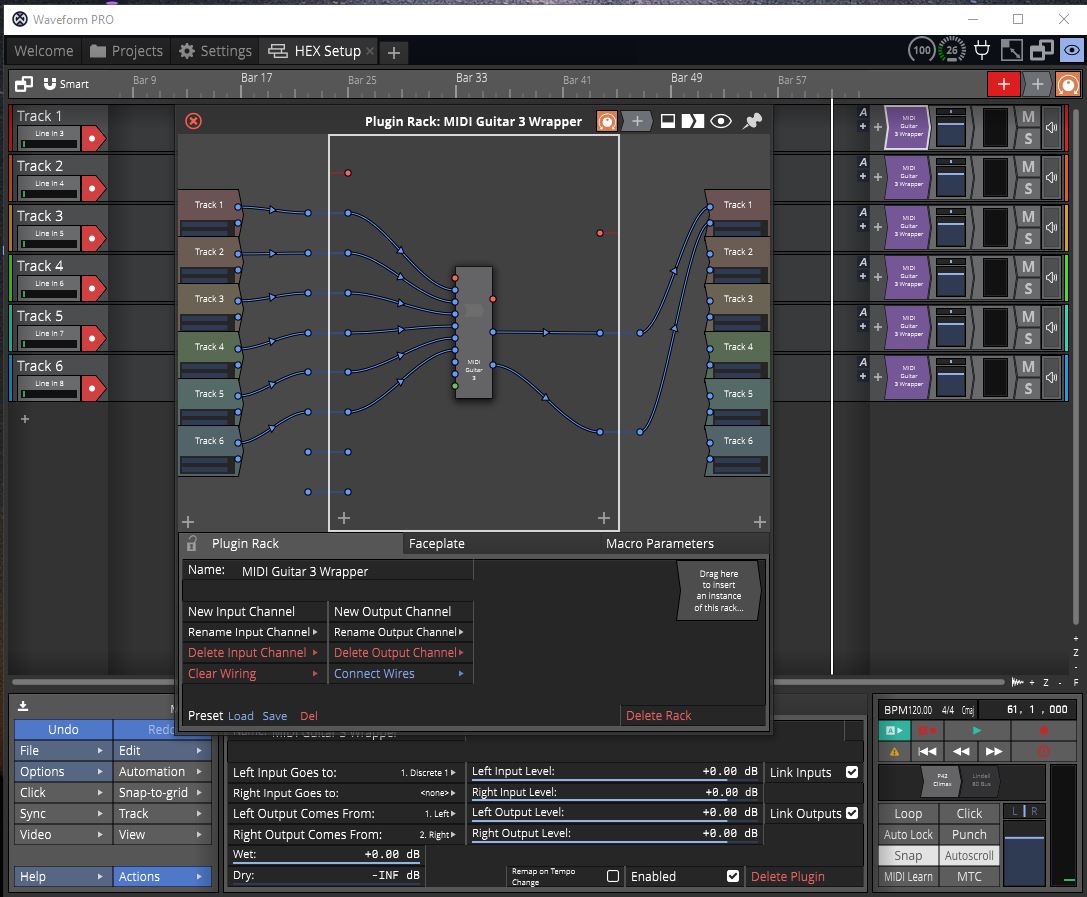
HEX Setup for WaveformPRO (aka ex Tracktion) users.
Basically you wrap MG3 HEX in their excellent rack and route everything as you see in the picture.
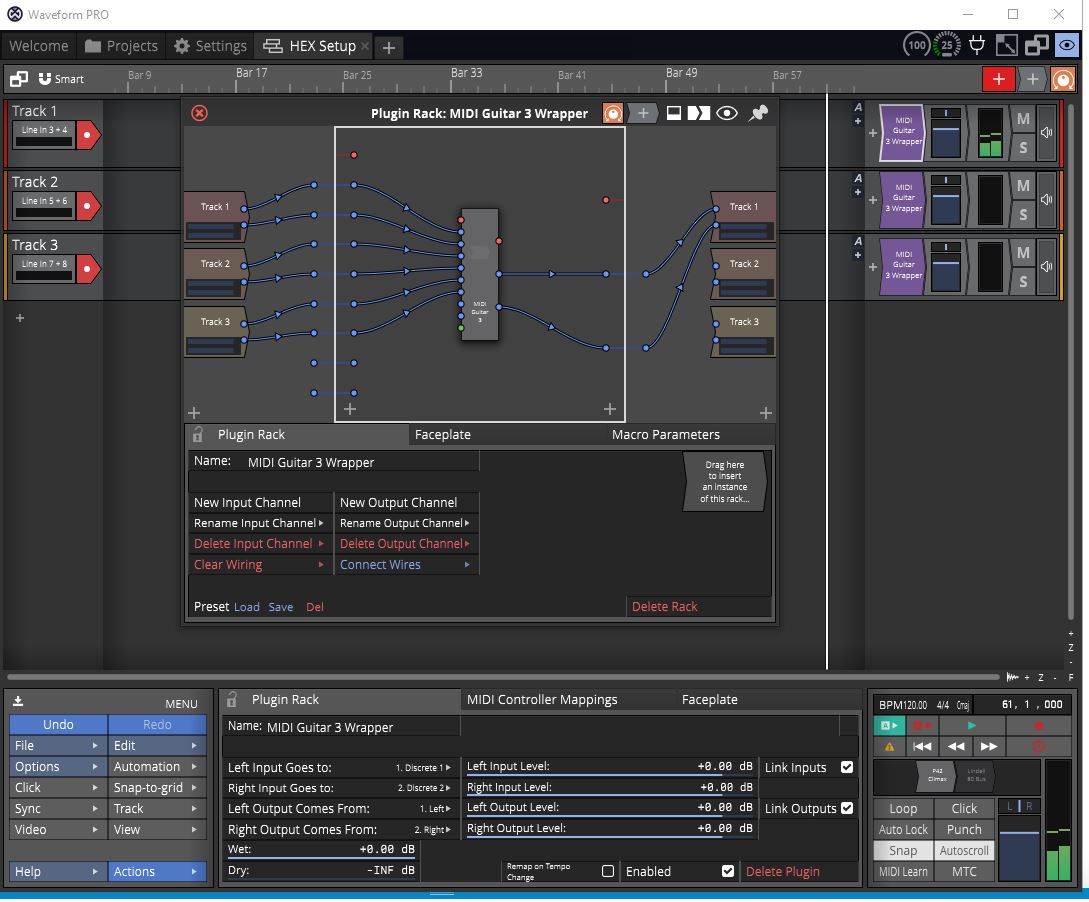
You can also use STEREO pairs for a more simplified setup with 3 tracks only.
I just picked up a GK-3 for super cheap and… does it really make tracking any better? I don’t want to get the required (expensive) pedal if all it’ll do it make octaves track better.
The HEX helps with cords only, for monophonic instruments like saxophone it makes no difference at all.
The cord issues are as follow:
1 - when you have two notes in a cord that are one semi-tone away MG3 gets confused and usually does not play one of them. (or one of those notes fades out two early)
2 - when you play a full 6 note cord, some of the notes sometime get lost.
3 - On cords with large gap between the notes, think open E and the rest of the cord at the 12th fret the low E with overshadow the higher notes, some might not sound or just fade out too early.
The HEX will fix all these issues.
You do NOT have to get the “required (expensive) pedal”, you can just use a direct breakout cable into an audio interface that has 6 available line inputs.
More info about the cable here:
As far as strumming on piano, yes the HEX will help but you also need a good setup that allows you to run at low latency. (depends on computer and audio interface)
PS
I realized the “struming on the piano” was posted in a different thread. More info here:
3 Likes
ElektroFuzz, you have described very nicely the tasks that lie ahead of MG3 Vanilla as a poly audio tracker, which MG3HEX as a 6x mono tracker has already solved well as a ‘diversion’.
Unfortunately, with MG3HEX you still have to overcome major hurdles and spend a lot of money on additional features in order to use it. However, this is only possible for a small circle of guitar players, most of whom already have this technology.
The original mission of the inexpensive Poly tracker MG3 Vanilla of ‘plug and play’ for all has so far only been partially fulfilled, which I would like to remind you of and which should give many more people access to Guitar to Midi:
No hardware requirements
No need for inconvenient special pickups and no physical mods. Our solution is a pure software solution that will work on any of your guitars, not just one. It integrates seamlessly with your digital audio workstation and can process old recordings as well as live playing.
Polyphonic
The Worlds First real-time polyphonic audio tracker. It tracks finger playing and complex chords as well as monophonic leads. It detects hammer-ons, pull-offs, slides and bends and transparently deals with different pickup types, intonations and fret noise.
I hope that this original mission will continue to be at the centre of JamOrigin’s future development… 
1 Like
i don’t notice any significant general tracking improvements when comparing mg3hex to standard. the only exception to this is when i’m using a slide.
what are your issues with mg3 standard’s tracking? latency-wise i don’t really think you’ll see much difference.
there are some non-latency related reasons to use mg3hex:
- instruments can be mapped to fretboard zones
- open tunings
- @prehm 's cv synth per string concept
for the price of a cable i’d say it is definitely worth messing around with. but if you also need to buy an audio interface, maybe not.
tweaking your current system for mg3 standard may be all you really need.
Thank you so much for this! Yes my main concern in chord tracking but my audio interface doesn’t have 6 inputs so a breakout cable won’t do.
Would you happen to know if the Roland GI-20 will work with MG3? Roland - GI-20 | GK-MIDI Interface
I don’t need all the fancy guitar-pedal related features of the GP-10 so the GI-20 looks perfect (so long as it works with MG3)
Latency isn’t my main concern. MG3 is amazing but it does seem to lose track of the notes in larger chords - which is what I’m looking to address with the hex. I have my eye on the Roland GI-20 I’m just trying to understand if it’ll work with MG3.
Signal path would be GK-3 pickup to GI-20 interface to laptop via USB
My knowledge and experience with Roland equipment is limited but I did not want to go that route to begin with because of the following issues:
1 - I’m on a PC, with ASIO I am limited to one audio device, I can not use both my audio interface and the Roland interface at the same time. I have been told that it might be possible to do so with “ASIO for ALL” driver but there is no way in hell I would use that driver instead of my manufacturer optimized audio interface driver that was custom build for my device.
2 - How much is a GI-20? How much is a 6 input audio device? Is the GI-20 cheaper? I don’t know, there are a lot of possibilities out there.
3 - GI-20 is a legacy product, I do not know how good are their drivers and will it work right in the future. I also know nothing about their USB latency.
4 - I’m not sure how much this matters but with my individually shielded custom cable I get better channel separation, dynamic range and signal to noise ratio then any Roland setup can give me.

PS… reading online, I don’t think GI-20 sends 6 audio channels over USB.
I believe the minimum you will need is Roland GP-10.
Others might have more info on this.
2 Likes
As @ElectroFuzz mentioned the GI-20 will not serve your needs. Only MIDI signals are processed through the USB port. The device doesn’t send the separated audio signals “outside” the box.
2 Likes
Thank you again @ElectroFuzz and @Dutti67 very helpful info
on this issue it is worth checking your pickup height. might not make a difference, but it’s also one of the easiest adjustments to make.
also infinite sustain is worth a try.
GP10 is the minimum as already said. However at NAMM on 16th January Roland/Boss will showcase new HEX device with new technology (GK-Serial) as GM800. Keep in mind that GP10 USB drivers could become obsolete at some point in the near future, making GM800 and the new Mystery device the de-facto minimum. SY1000 is based on old GK technology but it’s younger compared to GP10 so driver support should last some years.
Well said my good sir👏
I myself would not even go the mg3hex route if i didnt have the roland systems before. As it would be cheaper to get a tripleplay express or a jamstik and the tracking isnt far off either
any gm800 users - does it still have that annoying problem which plagued the sy-1000? (boss tone studio must be closed when the product is being used)
i think boss would be better served to offer a product more along the lines of what @dutti is designing. they should aim for a $300-$400 price range, otherwise they just can’t compete against mg3, both cost and performance wise.
synth guitarists don’t want their amp sims and guitar efx and they will just not accept that.
if they had a $300 solution with accurate midi out there’d be lines outside every guitar center.
1 Like