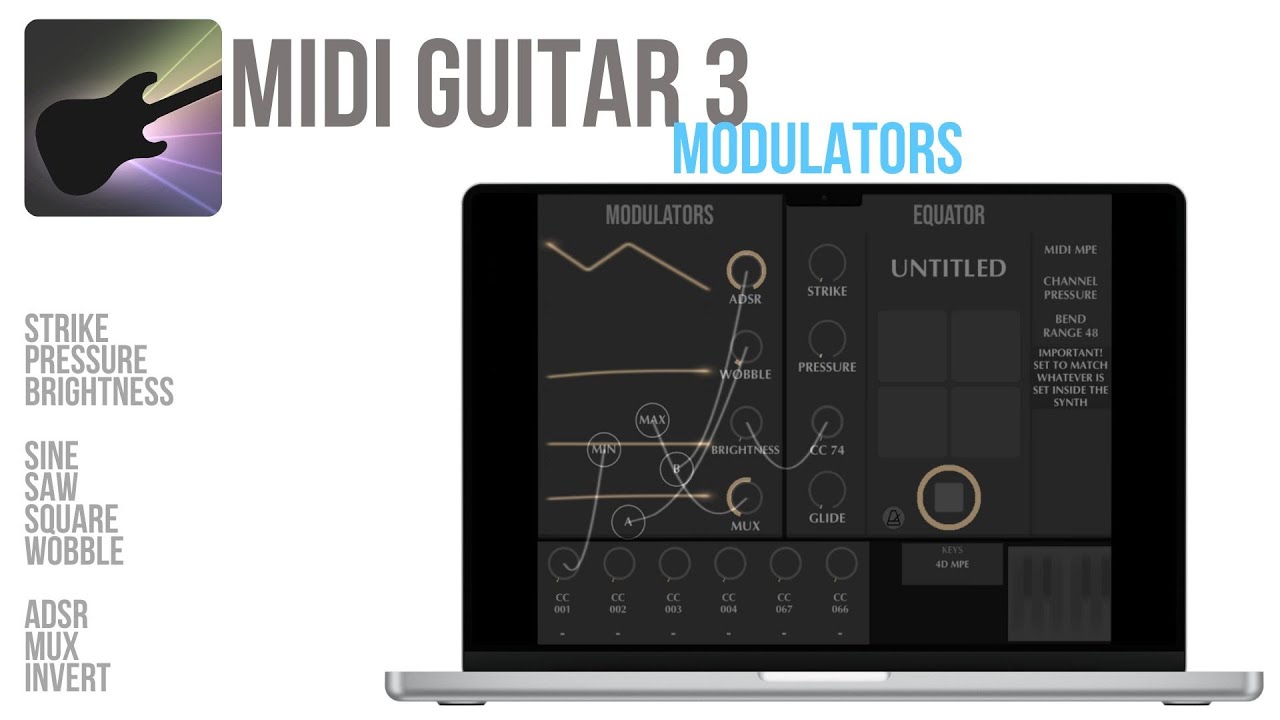
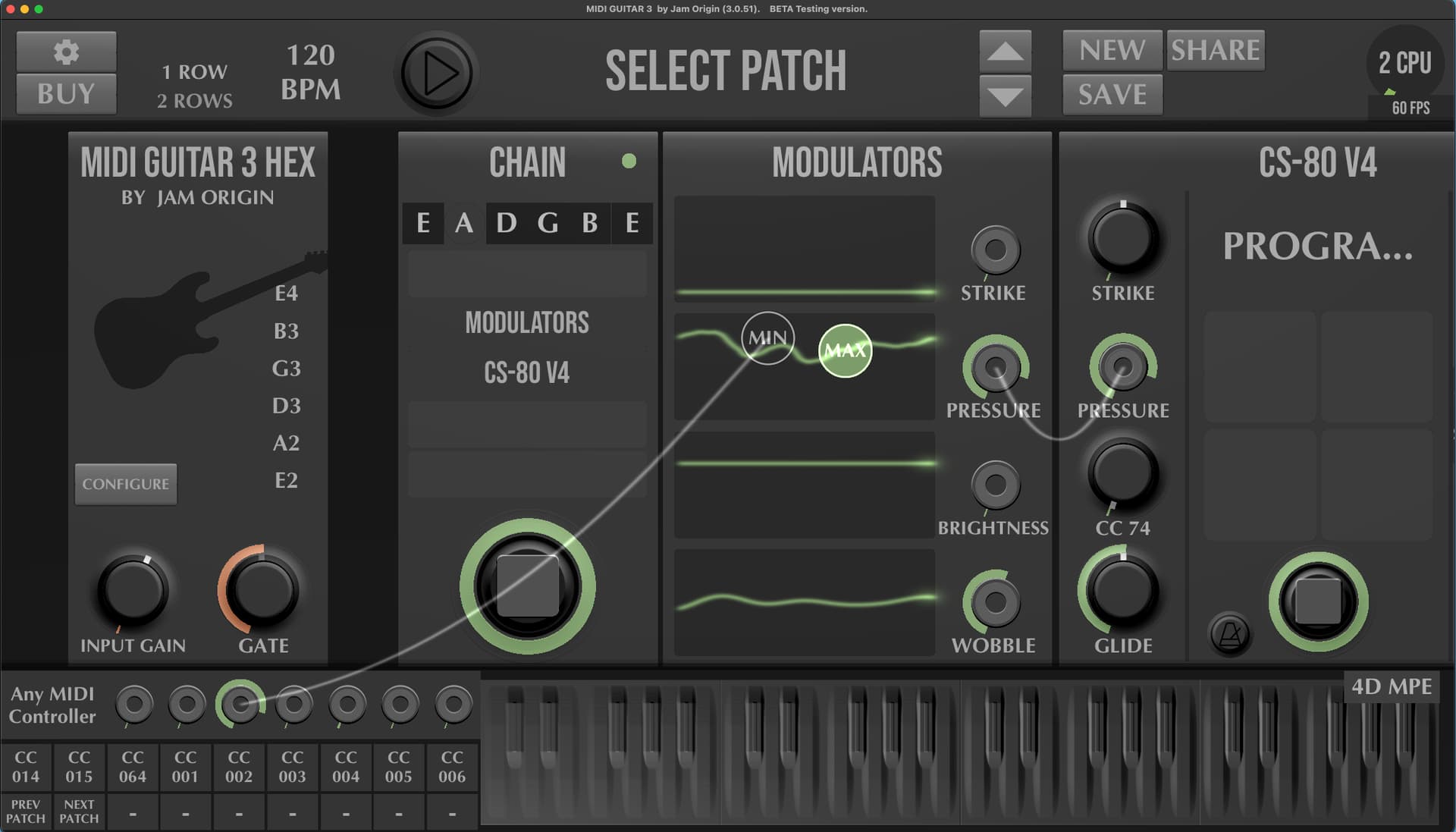
MG3 vanilla and HEX surely detect poly-pressure, poly-brightness, poly-pitch, poly-strike. Look at the pressure meters, or the seaboard. Each meter will only display one note (the strongest) but all notes are individually analysed and transmitted, in four dimensions (pitch, strike, pressure, brightness), across all modules. Each midi machine will preserve the information (and transform whatever aspect its meant to) Try to open the MODULATIONS to see the envelopes.
When the poly pressure reach a VST synth, there is a selector to set whether the synth should interpret the poly-pressure as poly-channel-pressure (MPE spec) or poly-after-touch (old school MIDI) in that synth.
@Jamo I had a blast yesterday trying out and playing with the HEX add-on!
Prior to purchasing a license I was just wondering if this license also includes the upcoming HEX options tailored for Bass/Cello?
It would be nice if the license covers guitars/basses/cellos/violins equipped with 13-pin out.
Or will the HEX feature for Bass/Cello be separate licenses?
I never got around to even trying my bass or 13-pin electric violin yesterday, got stuck with the guitars and lost track of time! Looking forward to using non-standard tunings.
that doesn’t deliver ‘poly’ pressure though. yes, each string’s pressure will change, but all are tied to a single expression pedal. on an mpe keyboard i can add pressure to just one note in a held chord, i don’t think this level of control would be possible without 6 exp pedals. and i only have the two feet.
not that i’m complaining, i just wanted to be certain that i hadn’t missed a way to control pressure using the guitar only.
the reason i believe this is important is that many of the mpe synth presets we will use are programmed with a focus on pressure and slide modulation. as neither can be detected using string/note information, these will require additional external inputs.
Please dont turn down the sensitivity of GM800. It performs better, the more signal it has to work with. Instead turn down the input gain in the MG3HEX interface. Try to set the input gain where the meter is almost silent when not playing. After that set the GATE to filter out ghost notes.
Its possible we need to fine tune this more for the GK5, but low velocity (in MG terms strike and pressure) you can always turn up losslessly, either by strike/pressure knobs on the synth module, or insert a GAIN module, before the synth.
Do you all have recommendations for hex pickups/processors? I see you are talking a lot about the GM-800 and GK-5 combo here. Do you recommend that over the GK-3 / GP-10 combo?
I am looking for one that I can use along side my universal audio apollo and just plug into my computer via usb or w/e so I can just get the midi in without having to have 6 inputs on my interface taken up etc…
I guess I also would consider getting a pickup like this SubSix – Submarine Pickups and using the ADAT input on my apolllo 8
Sorry if this post seems uninformed–just learning the tech here!
so you’d run mg3hex standalone on the gm800 and patch its output into the apollo? seems a waste to drop back down to analog.
also once the vst version of mg3hex is out you might want everything running through the apollo, that would probably be less complicated. there’s lots of adat 8 channel input devices which are half the price of the gm-800.
thanks for sharing the subsix, that looks like a solid match for mg3hex.
Well I assume I can run GM800 as a second audio interface or w/e-- or how does that work? I watched the LoFi Leif video on this MG3 hex and I couldn’t quite figure that out. Currently I used metaplugin within protools with MG3. Maybe I could do somehow a 6 input track in protools (once the VST is released for hex). Or I could use loopmidi and run standalone maybe and pass midi into protools
Gotcha! Yeah I am thinking getting one of those Subsix hexaphonic pickups and maybe an 8 channel adat preamp and an 8 channel DI box. The total cost of this gets up there though… But I think that may get expensive if I need hiZ on all of the inputs. The advantage of this setup is I can also play with the hexphonic acoustic sound and pan the strings around but maybe GP-10 and other hexaphonic processors can already do that
i was experimenting with controlling pressure using a force sensitive resistor. this seems workable.
can you think of a way to have mg3 use the higher of the two values - ie: if the fsr value is higher, use it, if not use the existing mg3 derived pressure value?
or if i could chain them together and transmit mg3 pressure + fsr pressure that would work.
this would also be helpful if i was using an exp pedal. if the pedal starts from zero it will sound unnatural. if the pedal adds to the existing pressure rather than superseding it the result will be more musical.
this is definitely an area worth exploring. in addition to panning, hex fuzz is fun. also the deep effexor, i haven’t fooled around with that using the hex version yet but i am guessing it will be pretty neat.
the Audient Evo SP8 Smart Preamp is worth a look, ~$500, has an auto level feature, preamps on every channel.
another issue with the gm800 is that it isn’t designed to be an audio interface. it lacks knobs like direct/computer, headphone volume, and input level controls. no balanced outs is a killer for me. i don’t know if you can aggregate it in protools, but even if so it’s really not optimal for the task because it was designed for a completely different purpose.
That would be something like a pressure filter function perhaps, but with the task of just passing on the highest value from any set of values?
There are no Pressure filter functions right now, but it doesn’t sound like something impossible for @JamO to achieve.
It is important to decide which handle you connect your controller to. Connecting to the MIN handle gives you acess to control over the decay whenever the Max handle is placed above the Min handle. If you on the other hand place the MIN handle higher that the Max handle on the Press curve/envelope you will get an increase in pressure (as opposed to the natural decay from the strings loss of energy). And for that scenario you best control the dynamic evolution by connecting your controller to the MAX handle.
Now YOU decide if you want this to apply to just ONE note in a chord (using the string filter) or all notes, as would be the standard case.
Your settings of the MIN/MAX relationship witll decide where the dynamics start from.



 Looking forward to using non-standard tunings.