MG3 not asking for mic permission on macOS

I’m running the latest versions of both MG 3 and Mac OS, and no matter what I do, MG never asks for permission to use the mic, and therefore I can’t do anything with it (and no option appears in the mic security preferences, since the app needs to try to use the mic first before anything shows up there=. I’ve tried deleting and reinstalling MG and its support folders, I’ve tried launching the app via Terminal, I’ve tried resetting the microphone settings via Terminal (bash tccutil reset Microphone)… nothing works. I downloaded MG 2, and with it everything worked fine immediately, so it seems to be a problem specific to MG 3 and the current OS.

Anyone else experience this? Any other ideas I could try?

I’ve seen this problem with various other applications but never MG3. Which version of macOS are you on?

26.5.2

And yeah, based on the similar posts I was able to find via Google, it seems like a fairly common issue with other apps. I followed all the advice I could from them, other than one about manually adding the app to some SQL database file that records which apps have permission, because that one was a bit beyond my knowhow.

I was always able to restore a mic permission in Mac => settings => privacy and security => microphone

Where there is a list of all apps and you can toggle permission.

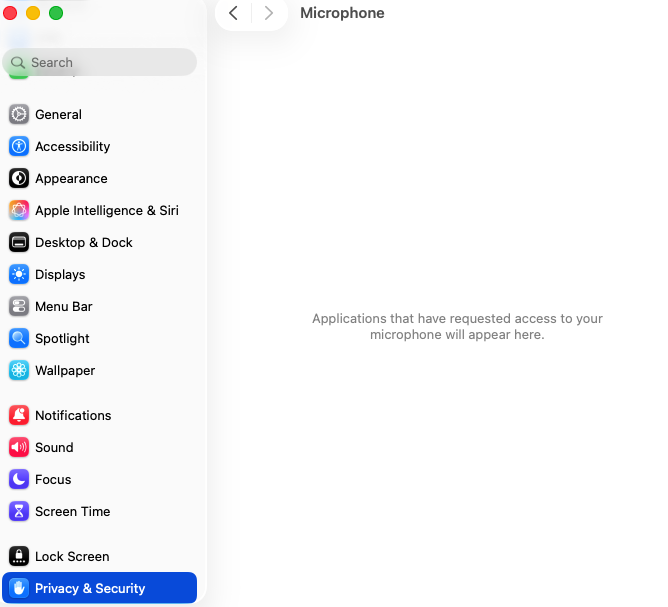
There is no permission to restore because it was never granted or denied in the first place. The app is never generating any request. In fact, having reset the permissions setting, there’s nothing at all there now. As it says, “Applications that have requested access to your microphone will appear here.” The problem is precisely that MG3 is never requesting access.

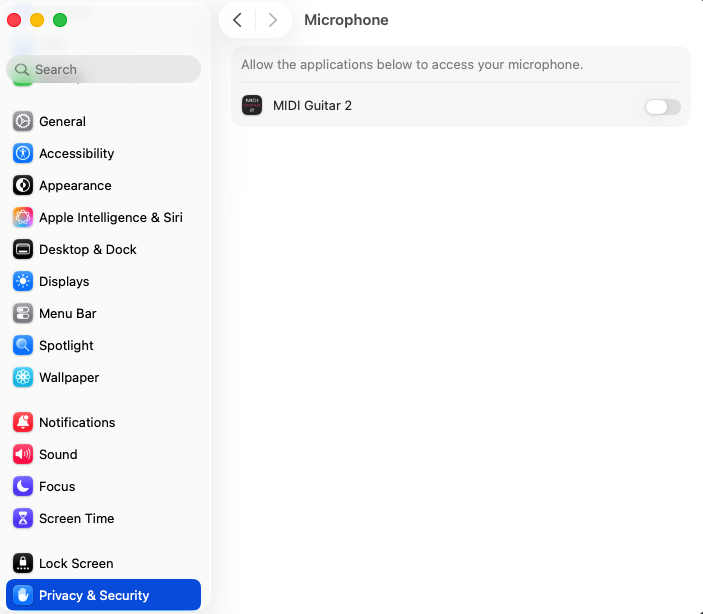
Whereas now, if I try to open MG2 again, it will ask for permission immediately, and if I click “no”, as I’ve done here for demonstration purposes, it will show up in the settings pane:

Edit: So in other words, it works exactly as it should for MG2, but not for MG3.

Just a thought — perhaps try opening MG3/activating the microphone permission under a different user account, just to see if it’ll work.

I was able to get it to work on my wife’s identical computer with identical OS, so at least that rules out it being a general issue for the latest OS.

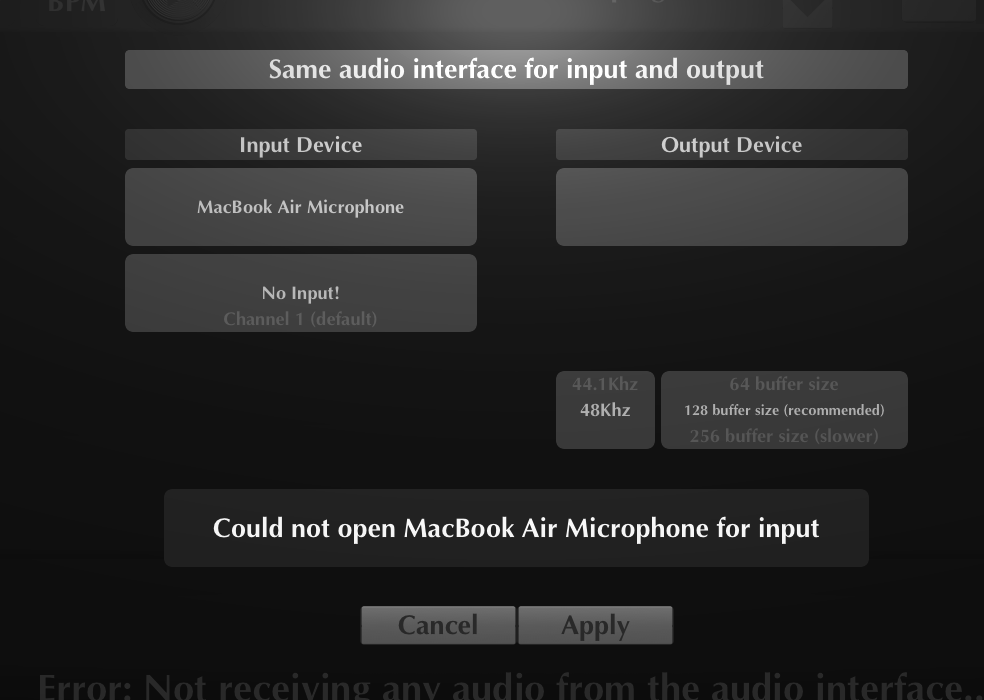
However, unlike on MG2, it did not ask for permission right away when opening the app. It only asked when I tried to set an input device. Unfortunately, I always get the same error message whenever I try to do this on my computer (with whatever device and input option I select):

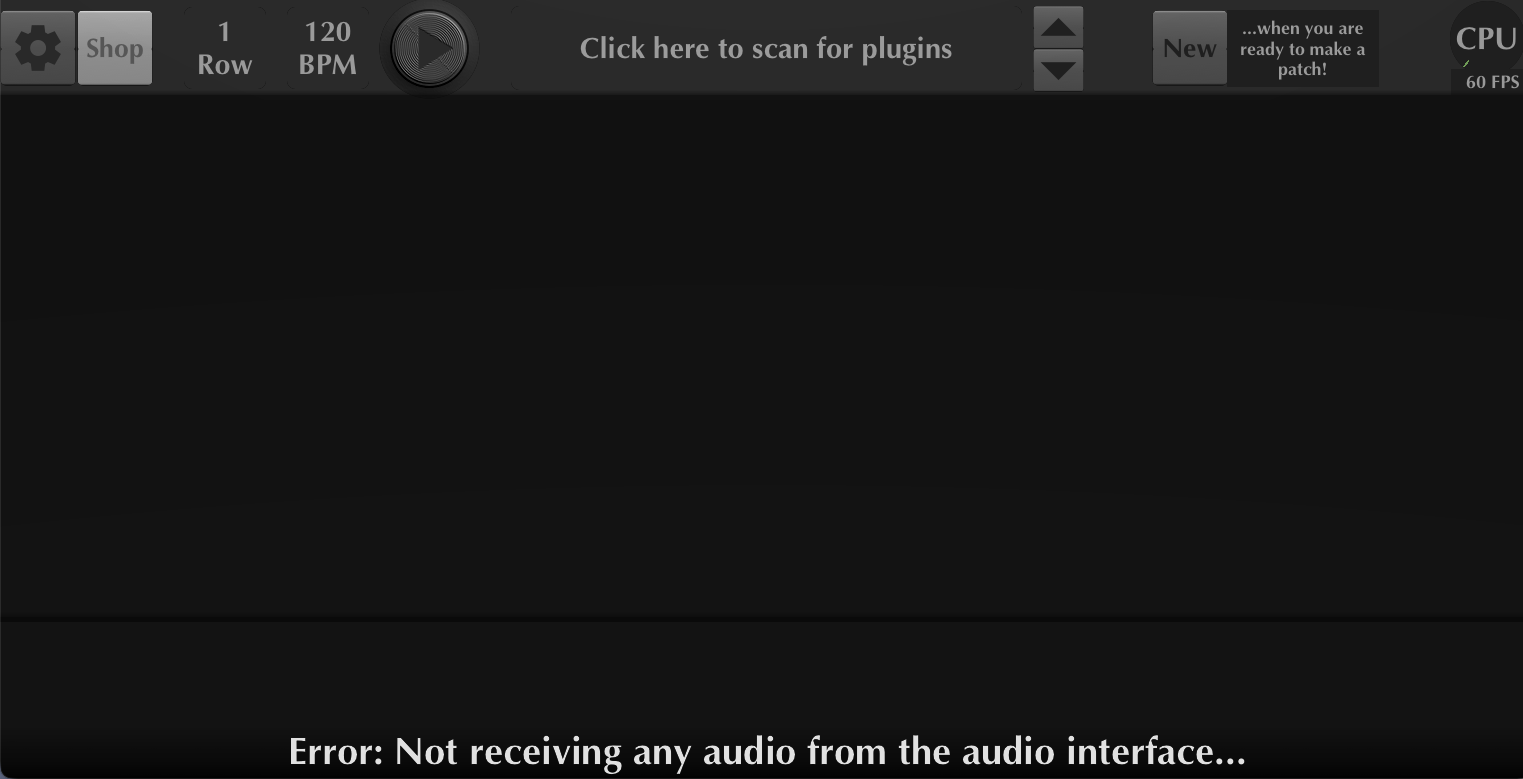
I tried deleting a bunch of extraneous devices showing up in Audio MIDI Setup, on the off chance that one of them might be interfering with something. Weirdly, after I did this and reinstalled MG3, I got this error message on the main screen, with the normal interface items (like the keyboard, transposer, etc.) all being blacked out.

I deleted everything related to MG3 following this thread, reinstalled, and that went away, but now I’m just back to the same error message as in the first screenshot.

I understand this is a frustrating issue. Correct, macOS will (should) ask for permission when an audio device is registered as I/O for the app.

Deleting extraneous devices seems weird. You can’t generally delete devices from the audio side of the audio-MIDI setup. You can remove (unplug) them or you can delete virtual audio drivers pretty simply. Deleting devices from the MIDI side will not have any effect on audio.

Note: if your mic (the only available device above) cannot be opened or hasn’t had an input selected (as above), then you will not get any audio passing. Hence the error message. So I’d at least give the input device a port (channel 1) that it can potentially open before writing it off. Also, no output = game over. You don’t have an output source in your MacBook Air – not even speakers?

I have not had any issues with MIDI Guitar 3, but had an issue with Tonex software on my M1 Ultra Mac Studio. It never asked for microphone permission and I could never get it to work on that computer no matter what I tried (OS update, software update, terminal uninstall, etc) until I wiped the machine and reinstalled the OS. There are definitely some gremlins in these latest versions of macOS.

Gil

Thank you for your help, guys. And sorry, I misspoke: I deleted some extraneous virtual audio drivers/devices or whatever they should be called, which were installed by internal audio capture and audio conversion apps. This was kind of a stab in the dark, but I just had a suspicion that some device (virtual or otherwise) was interfering, and sure enough, I was right… it’s almost definitely a problem with my external monitor throwing MG3 for a loop—and it seems to be a bug with how MG3 itself is handling it. I’ll explain:

For context, my MacBook has a broken screen, so I need to use it with an external monitor. This external monitor has the world’s lousiest built-inspeakers and shows up as a unnamed device in Audio MIDI Setup, with 0 ins and 2 outs. I had an epiphany and realized that it was also showing up as an input device option in MG3, but I wasn’t noticing it because it was showing up as a blank line. That made me suspect that the monitor was tripping up MG3 and made me wonder what would happen if it wasn’t in the mix. So, I disconnected the monitor and started viewing my laptop via screen sharing with another computer—an lo and behold, now everything worked as it should! MG3 asked for mic permission, and my interface worked the way it should work and the way it does work with MG2. If I leave the app open and reconnect my monitor, it continues to work. I was able to play some synth music with my guitar, and all was well—for a little bit…

But, alas, if I close the app and re-open it (with the monitor still connected), it goes back to the way it was before, so the above is only a temporary solution. The mic is now enabled for MG3, and this shows up in system preferences, but MG3 still says “cannot connect to X for input” if I select anything other than the blank line standing for my monitor.

However, if I select the blank line, it accepts that as an input, even though the result is zero input… which is to be expected, since the monitor has no input and has 2 outputs only. Which brings up the real problem: this device shouldn’t be showing up in the input list in the first place!

MacOS correctly identifies the monitor’s audio endpoint as an output-only device (0 inputs, 2 outputs). However, MG3 still exposes this device in its input-device list, where it appears with a blank name. It shouldn’t be presented as an input at all. Thus, this appears to be a bug in MG3’s CoreAudio device enumeration/filtering, rather than a problem with my Mac, monitor, or audio interface per se. The monitor getting through the filter appears to interfere with MG3’s initialization of all actual input devices. So my suspicion is that MG3’s input-device filtering/enumeration isn’t correctly handling this unnamed DisplayPort output device, and its presence causes the subsequent CoreAudio input initialization to fail.

As a workaround, I’ve tried to see if there’s anyway to disable the monitor as an audio output device, rename it, or otherwise block it, but this seems to be impossible, unfortunately.

PS, I just checked, and in MG2, the monitor doesn’t show up at all as an input option, so this seems to support my hypothesis that it’s a filtering error in MG3.

OK, it’s good that you’re getting to the bottom of things. Do you have access to an iPad that you can use as a temporary monitor?

No, unfortunately :frowning: In the meantime, one other thing I’m going to try, as soon as I find the right cable adapter, is connecting the monitor via HDMI rather than USB-C (as is currently the case), just to see if that makes any difference in how the device is registered by the app. Not sure why that would make a difference, but hey, you never know…

Final (probably) update: I tested connecting my monitor via HDMI rather than USB-C, and sure enough, it worked! Strangely, the (non-)name of the monitor still shows up as a blank line, so that would seem to rule out the problem stemming from its namelessness. Also strangely, it works now when I go back to connecting it via USB-C. And, one more bit of strangeness, it only works if the input and the output devices are both set to my audio interface. If I try to select any other output, it goes back to throwing the “Could not open [insert input device name] for input” error, both with HDMI and USB-C.

Anyway, I can live with it the way it is for now, but I’m reporting all this in case anyone else ever encounters the issue. Now I’m going to move on to the real challenge: figuring out how to play my guitar and use this app in such a way that it doesn’t sound like I’m playing a synth while my five year old cousin hovers around me and occasionally bangs on some random keys :joy:

1 Like