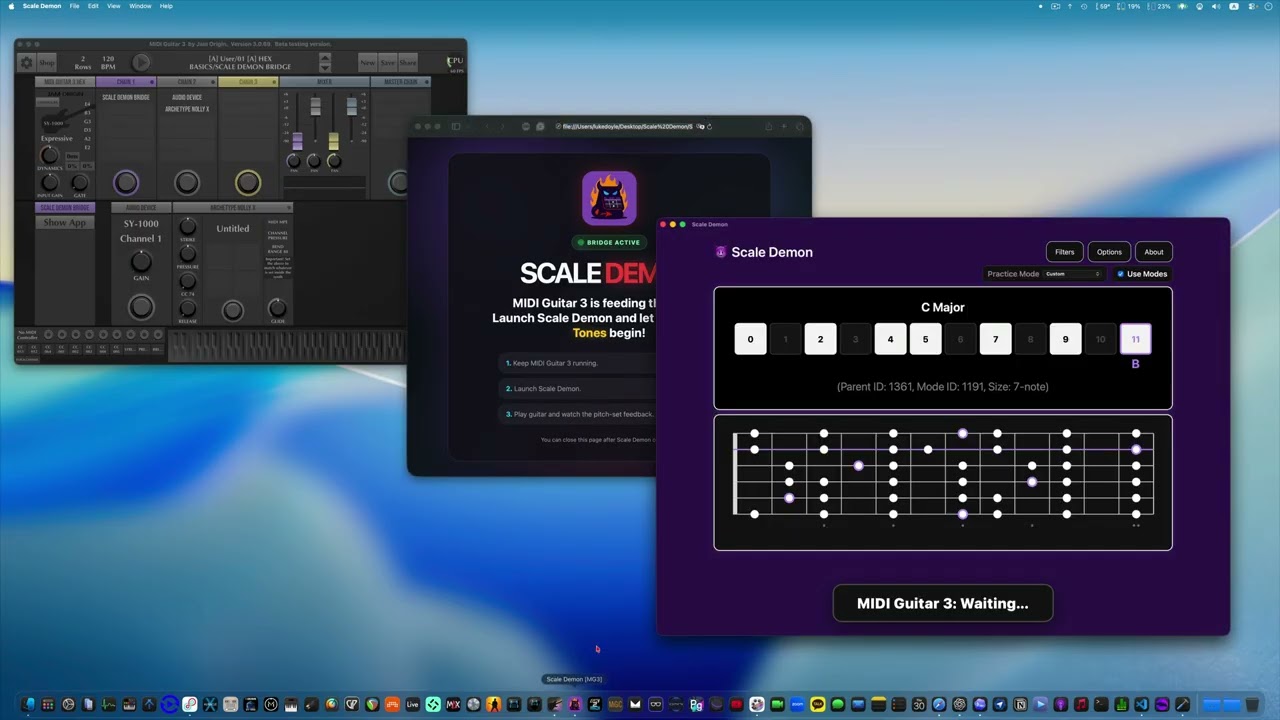
It’s coming along…

It’s coming along…
Oh yeah  . This looks really useful!
So it challenges us with random scales and then maybe it can measure our learning progress?
I did’t see this coming 
Yes, indeed. It’s been a long work in progress.
The app challenges the player to decode/recall pitch sets, which are represented in a number of ways to suit different musical brains.
In this very brief demo, I only used four scales (and their modes depending on the generated drone note), but there are over 2000 possibilities when generated from a static root.
If the player is disciplined, they don’t need pitch detection to make Scale Demon useful, but the MIDI Guitar API is the icing on the cake as it will make it possible for the app to track a player’s performance accuracy and help them to make better decisions about practicing.
on the other hand, let’s say the player is undisciplined and somewhat lazy.
it’s probably not a stretch to set things up so that any note i mash my finger down on, any place on the fretboard will be a ‘correct’ note. couple that with a pedal to change scales and it’s instant holdsworth (okay, it’s not).
just saying though, a tool like scale demon can be used for evil as well. please continue on.
I expect “Instant Holdsworth” mode to be among the most requested of features. 
FWIW, I’m trying to take some of the hard yakka out of learning this kind of material so it can appeal to a broader range of musicians with different creative goals.
i’m very curious to see what happens with one type of user - the hotshot kid with the lightning fingers but not much in the way of training in music theory.
i suspect that scale demon will produce child prodigies galore.
Gamifying practice. What a great idea!
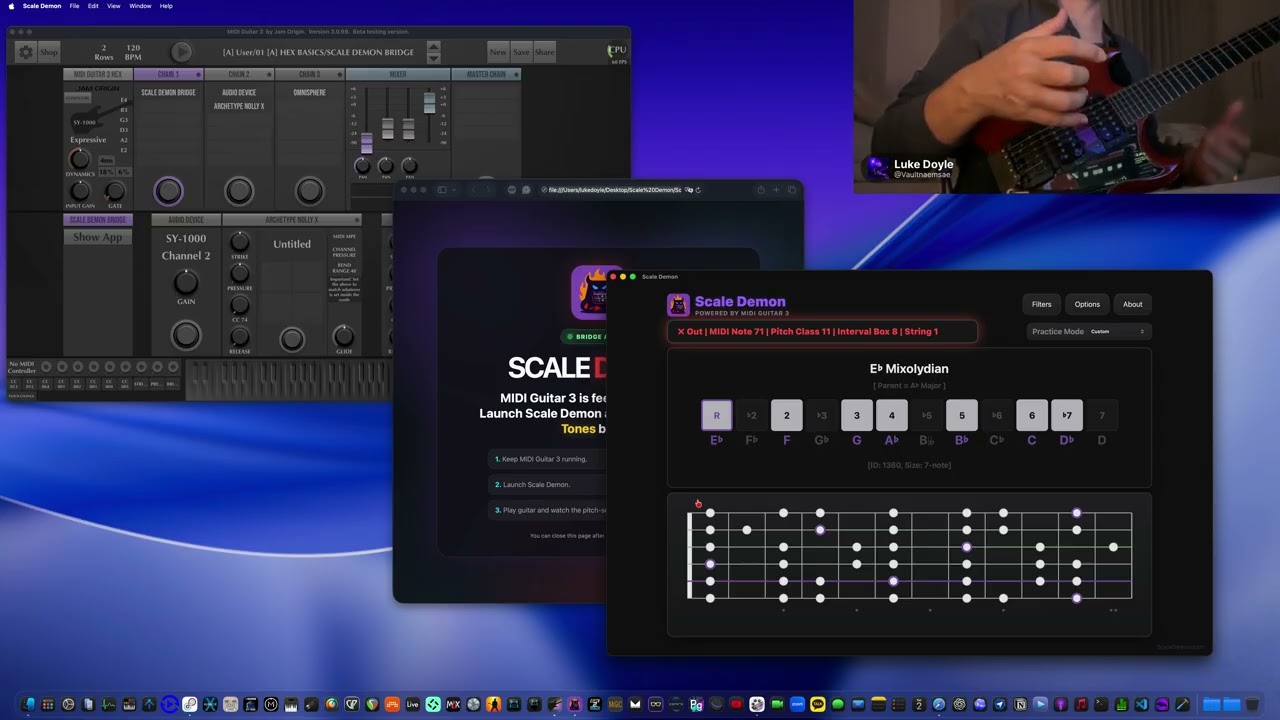
The app has just undergone a bit of a visual shift to a dark look for a hopefully clearer display of data.
MG3 Hex-generated data triggers green (correct  ) / red (incorrect
  ) visual feedback in both the interval boxes and the fretboard diagram now. Features around analysing user “success” and scoring, to come.
MG3 vanilla works for the interval boxes too, but coloured feedback does not work properly with the fretboard diagram. That’s another place where MG3 Hex knocks it out of the park.
This can totally work with vanilla MG if you color all (3 or so) the notes with the same pitch when there is no string information available.
How about reducing pressure of red notes so you have audio feedback on misses? I think the MG scale filter does that just to test how it feels.
@JamO, I’m sure you’re right and I just haven’t quite figured out all the intricacies yet. Presently I’m trying to display 12 frets on the neck, but probably in practice, smaller sections of neck are more realistic for common position playing and that should make it easier to display inferred input.
That’s a really good idea about pressure reduction for direct audio feedback. Now it’s a bit one dimensional and the synth/guitar audio are in no way connected with anything happening in Scale Demon, they’re just so I can hear what the actual input is.
All that said, there’s something very attractive about the way MG3 Hex knows exactly what your fingers are doing.
Honestly, I’m just thrilled that the dots are lighting up! But you’ve already got that covered in MG3’s GUI. More to come…
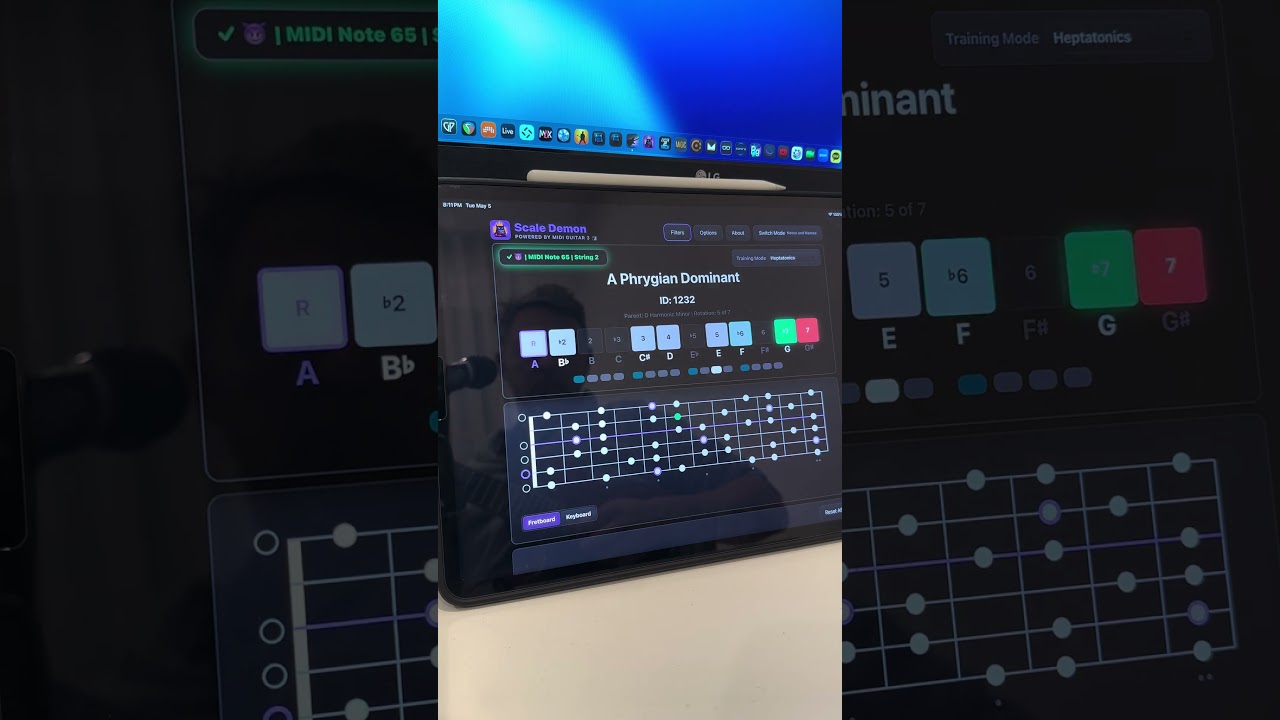
Today I compiled a version of Scale Demon for iPadOS that supports network communication and MG3 pitch detection can be sent to the iPad from macOS.
On the one hand, it’s crazy cool that it works. On the other hand, if you were using MG3 Standard or Hex on your computer, why wouldn’t you just run both apps on your computer?
Anyway, just for fun, another demo. You can see some new design elements. Many of the events you see are because I get a bit fiesty with the vibrato arm, which inevitably registers as playing notes outside the active pitch set. 
i really like the scale demon logo and the color scheme.