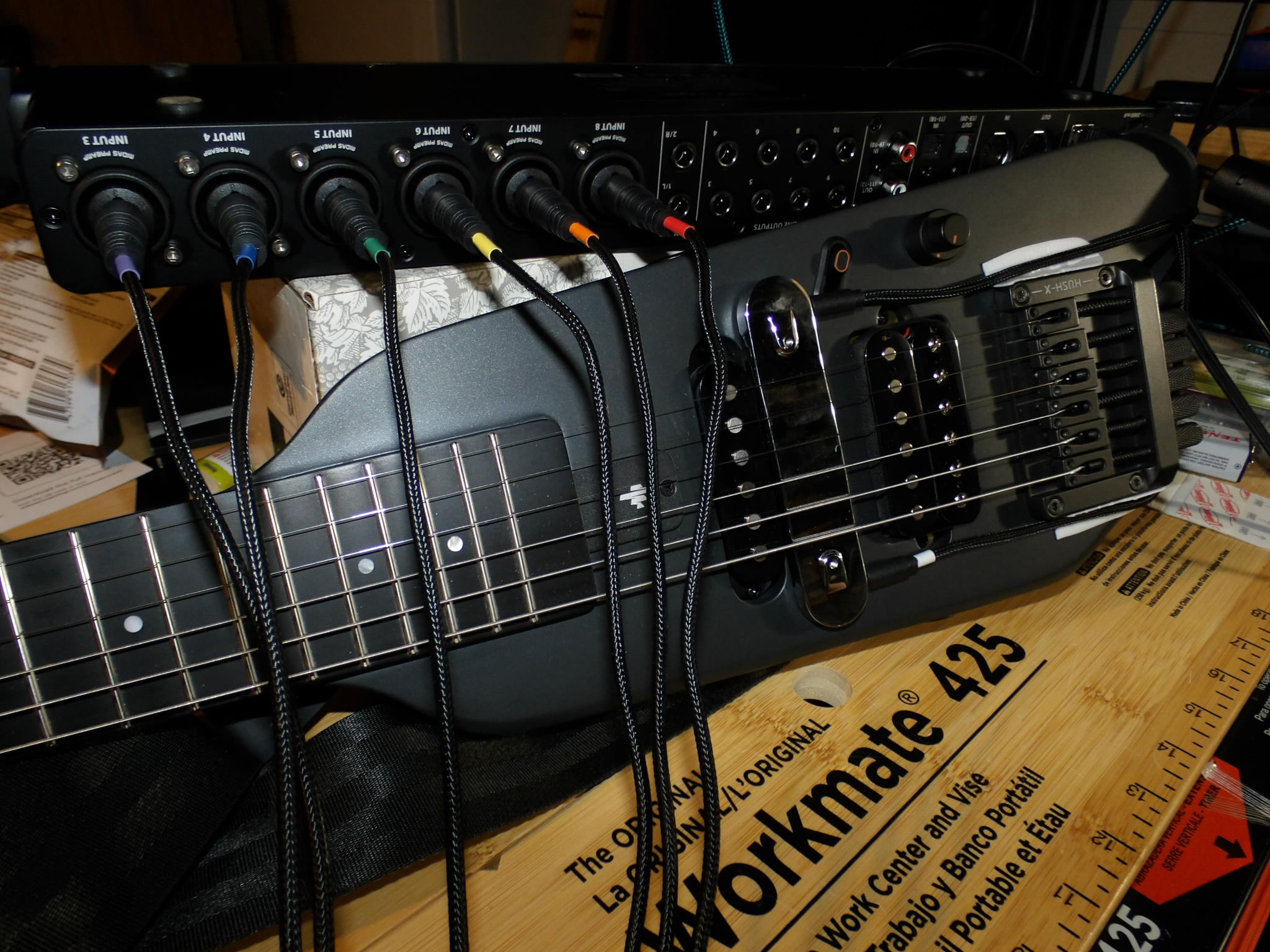
post-tariffs pricing will be worse for those in the states, i got lucky and got mine on the last tariff-free day.
the subsix sounds great. on some guitars it may require setting the action higher. the ‘nano’ grips (surprisingly) do hold the pickup in place, as long as the cables are otherwise secured.
the cables seem sturdy enough. they’re not long enough for use onstage without some kind of extension. they should be fine in the studio.
it’s nice that the pickup could quickly/easily be swapped to another instrument.
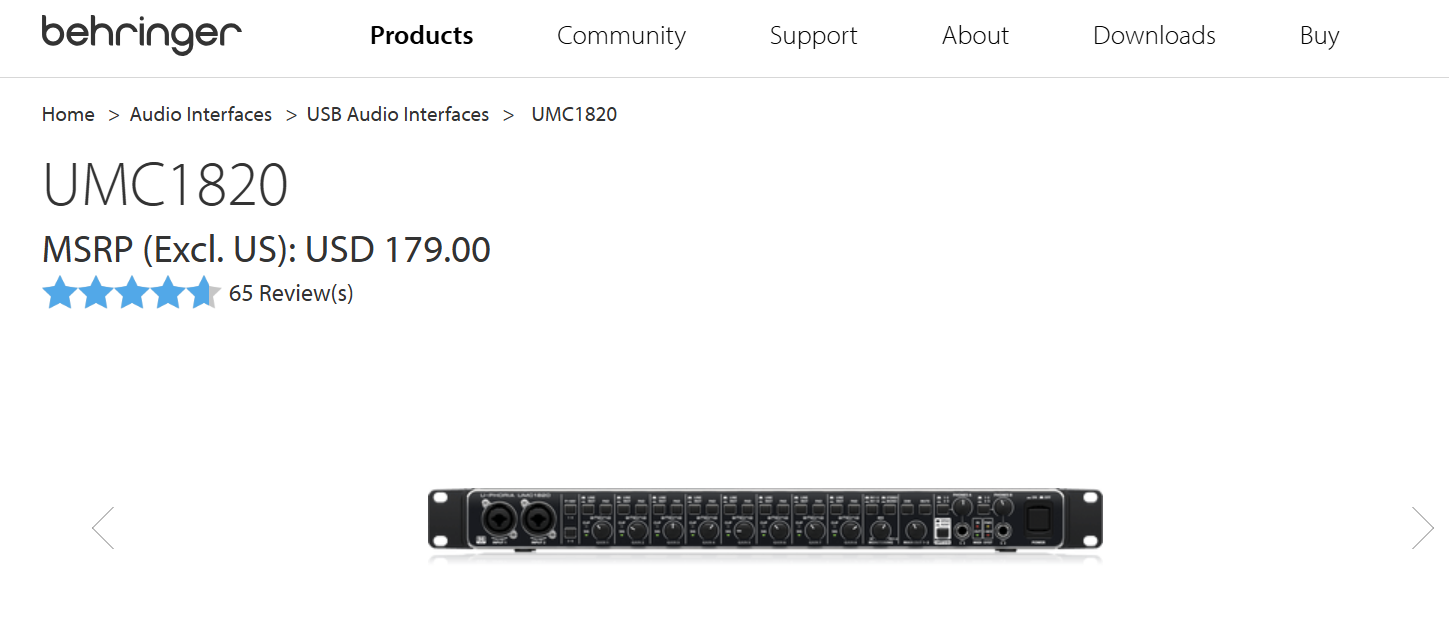
the subsix was $320 before shipping, the behringer umc1820 $230.
in mg3hex standalone at 128 samples with a loaded preset my cpu meter is red and almost fully pegged. but there are no crackles or artifacts.
neural dsp cory wang and tim henson are happy at 128 but rabea is non-functional with a weird pulsating effect. it is fine at 256, and the latency hit is really not that bad.
coming from the zoom l6 mini mixer, it is very nice to have dedicated individual string gain knobs. dual independent headphone jacks are also very useful.
the win10 system i used for testing has a 3.0ghz i7-9700 with eight cores and 32gb of ram.
i thought the umc1820 was a good buy at $230, at $179 it is a steal.
probably behringer will survive just fine but sadly i feel that the tariffs are going to kill many of the small global providers needed by midi guitarists.
i only had the gp-10 for a month and that was 10+ years ago.
i did like it, but i also had a gr-55 and didn’t find much improvement in the guitar models, which were my primary focus.
so i’ve never used it as an input for mg3. but i still have some thoughts:
pros:
it does simplify cabling and has a smaller footprint than most other solutions
it’ll probably last forever
cons:
it lacks physical string level controls (i use these more often than i’d have thought)
unbalanced outputs
limited flexibility as compared to a ‘real’ audio interface (no mic input/phantom power, no independent headphone mixes/volume)
it is difficult to move/share the pickup
lastly i suspect that the subsix is giving me a superior analog signal as compared to the gk13, although i’ve never compared them side by side. but the ability to place it where one likes is a significant advantage.
I am thinking about the same hex setup and specifically whether it can create effects like vg-800: on-the-fly retuning, acoustic, 12string etc?
I was thinking about:
pitch shifting individual strings audio for retuning
adding +12 octaver for EADG + slightly detuned doubles/chorus for the BE strings for 12 str effect
IRs for more realistic acoustic sound. 3sigmaaudio seem to have IRs for “magnetic pickup → acoustic” conversion. Not sure if they would work with subsix DI nicely
Have you tried something like that? Maybe plugin recomendations?
I guess you can also go the MIDI way for 12string acoustic, like @LoFiLeiF shows here, but you pay with increased latency for pitch-to-midi and lose scratch and muted strum sounds in comparison with audio-to-audio approach.
individual string pitch retuning works very well. it is cpu intensive and thus limits the number of add’l instruments/effects. it will occasionally ‘warble’ if one does not watch to maintain sufficient finger pressure.
there is no acoustic emulation option, although piezo’s do sound pretty acoustic-y. i’m hoping this will be a key new feature in mg4.
for 12 string i haven’t tried this but i bet either two hex string retuners in different channels or two copies of mg3hex would give you your choice of open tunings, each with a secondary octave, and at the lowest possible latency.
shame that 3sigmaaudio doesn’t have trials. otoh, $15 is a fair price. the demos sound solid.
this video shows hex string retuning on a guitar strung with all ‘b’ strings:
i installed the graphtech hexpander on a $180 ‘batking’ lap steel from amazon.
in my view, piezo’s are superior to the gk options for midi note detection. i don’t use a pick so my experience probably doesn’t apply to most. some might argue that for hex use piezos are more prone to crosstalk.
i’ll copy my note here from the other thread for people considering the subsix:
I use various guitars with the graphtech hexpander installed. I also do not use picks to play and crosstalk I have never experienced (6 single tusq saddles). The raw sound of the piezos is so much better than the raw GK3 or GK5 signal. This makes it much easier to use audio FXs without EQing first and still not really getting satisfying results. The lack of the mid and low frequencies you can’t just EQ into the spectrum. To me it always sound “flat” and unnatural no matter what amp simulation I use.
With the piezos this is a lot better.
I guess if you start with hex piezo source and apply octavers/chorus FX on individual strings, acoustic guitar IRs in DAW you can get more convincing 12str than from magnetic source. And this way seems more flexible than Boss unit.
this is the donner hush-x*, strung with all ‘b’ strings, feeding mg3hex via the subsix and alt-tuned to standard tuning on channel1 and an octave higher on channel2. the audio shifts between channel 1 only and both channels.
*for $250 (refurbished but mine was like new) the donner hush-x is very nice headless guitar. it weighs very little, tunes and stays in tune like a steinberger, it’s neck-thru and sustains nicely and the design is pretty well thought out, with all needed allen wrenches holstered next to the electronics.