when you say ‘often correctly’, do you mean 95% accuracy? 99? 90? (on ‘monophonic/linear’ playing).
is there additional latency when using poly mode?
thanks for taking the time to explore this alternative.

when you say ‘often correctly’, do you mean 95% accuracy? 99? 90? (on ‘monophonic/linear’ playing).
is there additional latency when using poly mode?
thanks for taking the time to explore this alternative.
Despite the care I take with my words, I think I slipped there. I’d pin it at very high accuracy, though I can’t give you an exact number. I’ll link to a short impromptu demo video I made for my own records.
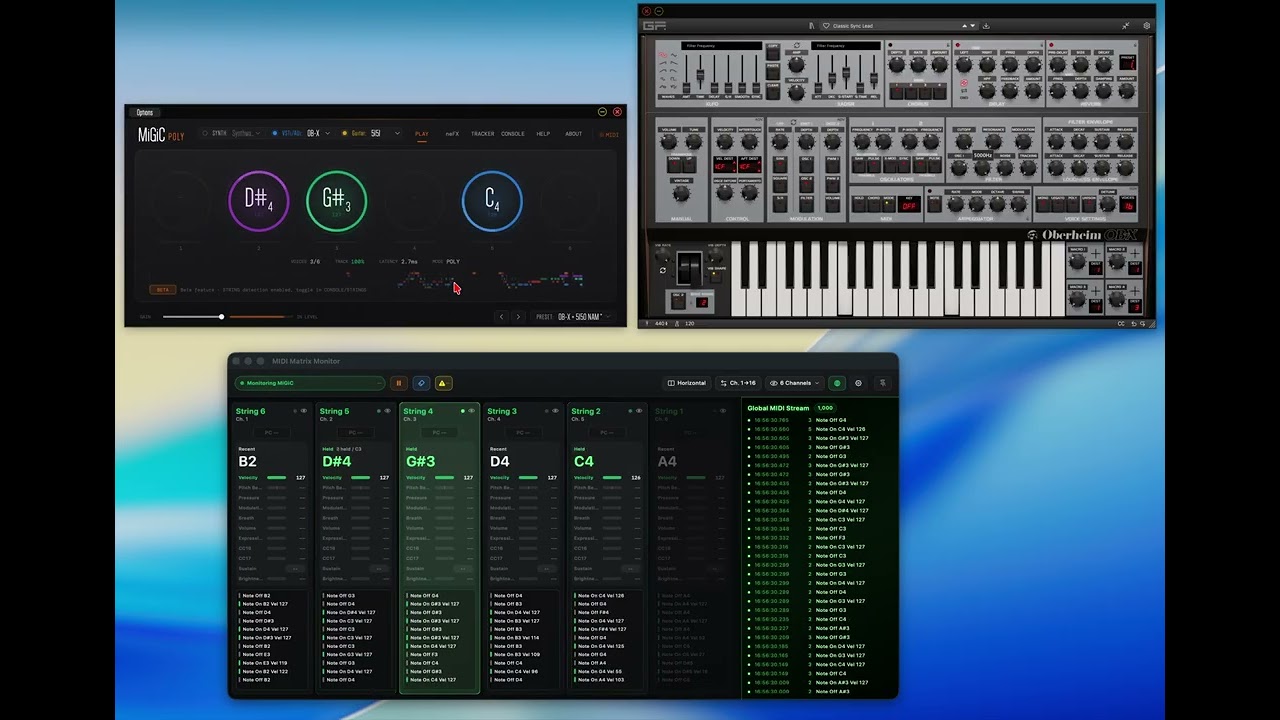
Hi @migic, congratulations from me as well on your groundbreaking development 
You asked for the following in this context: “Feedback is welcome, especially the critical kind.”
Well, you announced a new version here about a month ago: “The public beta opens next week.”
So far, there hasn’t been any news about this on the MiGiC website. You haven’t shared any updates here in the forum either.
What’s the current status? What’s new with MiGiC regarding single-string detection in polyphonic mode on a standard guitar without a HexPickup?
I’d be happy to see the project continue to succeed in this direction in the near future.
Hello! Thank you very much! Its been hectic the last few weeks, I have wrestled a seemingly trivial bug.. But it relates to VSTi/AUi loading, some instruments just didnt want to co-operate but I think a solution is near. As to the Beta, its actually live so the 0.1.10 features the string detection algorithm. Still the crude one but people can test it now. I have received some really constructive input that will be addressed soon, for instance inverting the channel mapping so that the low string gets higher channel etc. So for anyone interested, its now possible to test the version that I was running in the video in this thread. Cheers!
Hi @migic, is there any news on single-string detection? Is there now a changelog on the website for the versions of MIGIC Poly?
For better testing, it would also be helpful if you could curate a set of brass instruments for multiple single strings, e.g., D string for trombone, G string for French horn, B string for saxophone, and high E string for trumpet.
It would also certainly be interesting if there were ever a Linux version for the Pi-Pedal with Raspberry Pi 4 or 5, which has just adapted NAM A2:
Hi! I released 0.2.1 yesterday, I have a regression with gain control in the standalone version so there will likely be a new release soon again. Regarding the changelog/news Im actually creating a completely new webpage so its easier for you guys to keep track on whats going on. Hopefully I can get that out soon 
Thats actually a great idea, like creating a preset that outputs them separately from start? Do you have any opinion on channel order btw? Some customers appears to want to have high to low and other low to high.. configurable? Hope that all is well ! Cheers
your new webpage should include a forum. this one is for mg3 support, and it is long past time for this thread to move elsewhere.
as kind and gracious as he may be, i assume that jamo is not providing this forum for competitors to discuss their products.
move it to a new location, on your site, or on discord or whatever. this discussion does not belong here.
@kimyo And I’m assuming you’re speaking only for yourself, not for @JamO and not for the forum in general, since you’re not a moderator here 
I hope the topic of single-string detection sticks around here in the forum for a little while longer.
if you cannot understand that promoting a competitor’s product here is unacceptable i cannot help you.
i hope @migic will show the decency which you lack and talk about his product on his page instead of here.
@kimyo I don’t understand the fuss, and this isn’t about morality or decency either.
I think it’s important, for practical and scientific reasons, to take a close look at new solutions—like single-string detection here—and to assess how they might be useful for MG3 in the future.
In that sense, I see this more as a competition of ideas rather than competing products, which, in my opinion, are worlds apart.
did you not read jamo’s response to you?
tldr: these features are best served by hex.
he said no. you now have a developer which says yes.
a sensible person would focus their efforts in a productive manner.
a sensible person would accept ‘no’ for an answer.
the top five things i feel are way more important than your obsession:
i have five more, all of which i am fully confident the vast majority of users here would prefer to see than single string detection.
one would have thought this horse was finally, completely, irrevocably dead. but no, we have monty python’s parrot instead. he’s pining for the fjords. he’s stunned. he’s shagged out after a long squawk.
can i pay you to stop nailing the parrot to its perch? how much?
Just to set the record straight for anyone who hasn’t read the entire thread here:
@JamO didn’t say “no” to single-string detection for MIDI Guitar 3 Standard; rather, he said he wanted to take another look at it.
In addition, @JamO explicitly congratulated @migic on the presentation of single-string detection for Standard Guitar.
It is now generally clear to everyone that single-string detection is technically possible
Single-string detection for Standard Guitar and MIDI Guitar 3 Standard is being considered strategically and for the long term; that is, it won’t be included in the next update, but it could be implemented in the big update after that.
I will start a new thread in the near future discussing the benefits and advantages of single-string detection for Standard Guitar, where I’ll go over the topic again calmly and objectively from a guitarist’s perspective.
I tried it and then quickly removed it because it wasn’t working for me.
It’s hard to let it work because the same frequenties are available on different strings.
For now i stick to MG3 and wait for further improvements on the Hex module i.c.w Logic.