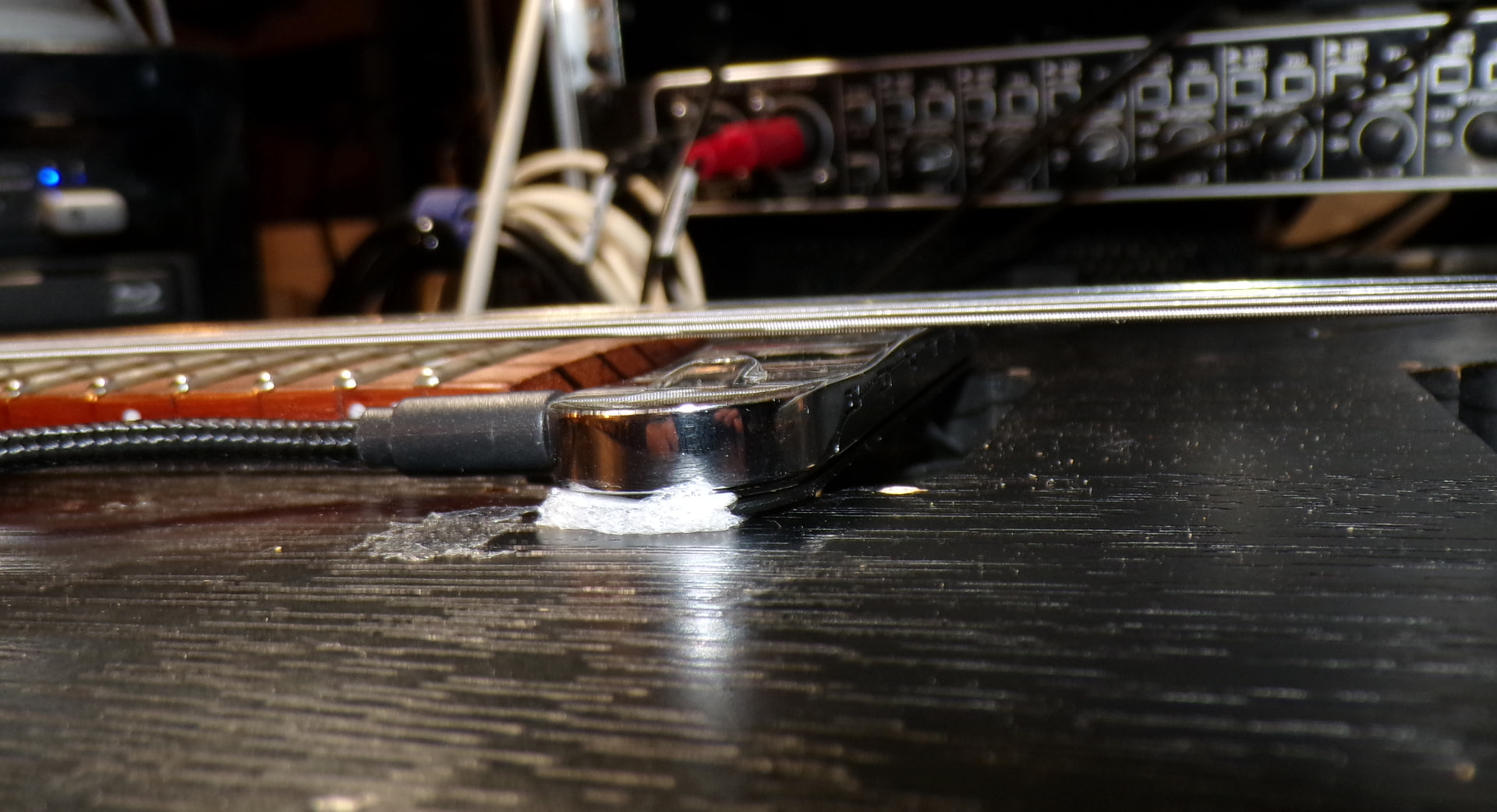
most, maybe all of my subsix time has been using BBBBBB. with EADGBE (on another guitar) the problem becomes more evident.
another factor is the body size, the BBBBBB is a travel guitar with essentially no body. the EADGBE is an ibanez rg421 and weighs more than twice as much.
the primary reason i use BBBBBB is that the latency is confined to a very narrow range, ie: E2 and E4 trigger in roughly the same amount of time. however i just read the following and i’m not clear on how it affects the total range:
Pitch range limitation: total cascaded pitch range of -24…+24 for hex
maybe this applies to the combination of string retuning and whammy or retuning and chordshift?
in any case, that’s a secondary issue for now. next up on my list: 1) find a way to fully isolate the subsix on the ibanez and 2) route out a cavity for the subsix on the travel guitar.
hopefully one or the other will provide further confirmation (or refutation) of the body xfer problem.
in your case, you could compare interference on your guitar as is, looking at the high E and B strings vs the low E and A. if you find a difference, that would support a tryout with all B strings.
note though that hex string retuning is cpu heavy, i’m willing to trade the cpu cycles for the fixed latency but you may not be.
That is interesting that hex retuning is cpu intensive— I assume that it would just do a midi transpose per string if the only output is an instrument and not audio. Midi transpose is likely not cpu intensive I assume.
So far what seems to help me the most is playing soft and turning up gain and perfectly setting the gate level. Playing soft helps because logically it reduces the body resonance issue (at least it seems like it…).
My main issue I’m trying to solve is the beating notes issue not latency. I may try the all B guitar and see how it performs. Thanks for the idea. So with only 24 semi tones I may not be able to get to every note from a b string. Maybe it can. I do custom tunings sometimes too
you are correct, midi transpose requires next to no cpu.
how and where is your subsix attached? what type of guitar?
the gate being effective kind of negates the body xfer theory, i think. as the string has already opened the gate, the gate won’t block the interference (if it is coming in a delayed fashion from the body). so, this may point elsewhere.
I have attached to a fender jaguar using the sticky pads that come with the guitar. It is right in between the pickups with around 4mm of clearance from string. Extra lite strings nyxl .009-.042.
Is there a midi transpose per string? (Hex version)
the string retuner is both for audio and midi. if you have a midi output on the chain it will do midi only.
i am starting to wonder if the fender pickguards are resonant in a way which exacerbates the problem.
they could be acting as a soundboard over a mini acoustic cavity, or perhaps carry/enhance a different part of the signal, causing increased false note messages.
if you have a little more vertical space near the bridge it might be worth trying the subsix there using the thicker pads.
if time allows please record a few separate string snippets, it would be useful to compare those with mine.
i have an ubertar quad bass pickup, like the subsix it is very ‘hot’.
i filed it away due to crosstalk, but this was before mg3hex became available.
so i can’t really give it a review as it applies to this case. but like the subsix it sounds great. i’ll dig it up once the weather warms up a bit and give it a more proper test.
i was thinking about this and it seems to me that an expander sidechain might work better than a gate.
slightly boosting the E string signal when a note is played on the A could reduce the note on/off problem.
i’ve got the subsix reinstalled with pretty decent isolation, although it is still too close to the strings. there’s a bunch of snow coming in, so hopefully i’ll have some time to test things out.
if the isolation doesn’t improve matters i’ll see about the expander.
now that the subsix is better isolated the second spike is no longer present. the frequency of the interference is significantly reduced.
in fact, on these you can hear the graphtech mistrigger when the subsix does not.
i have another set though with the exact opposite.
these were recorded simultaneously.
mg3piezo piano
mg3subsix piano
piezo input (E left A right)
subsix input (E left A right)
i have some thin foam underneath the mounting plate, and some thicker foam between the plate and the pickup. the only contact point between the pickup and body is the mounting screws.
So I mounted the subsix on my acoustic guitar and the problem of repeating/re-triggering notes is more or less eliminated. Could that be because the thicker mounting pads means less body resonance?
i’ve been meaning to ask someone here to try exactly that, as i don’t have an acoustic.
given my experience isolating mine, and yours with the acoustic, i think it is safe to conclude for the moment that the issue is isolation.
that’s not so great for those users who don’t have enough clearance to isolate. and it kind of eliminates some of the key benefits of the subsix (easy mount, easy swap between guitars).
True. I mean the subsix is still a great piece of kit without mg3. Luckily, Since I play mostly fingerstyle acoustic anyway I will probably leave it hooked up there for now. Thank you for all the advice and troubleshooting. It’s really appreciated
For me the biggest key so far is playing super soft with the volume cranked. I assume this decreases vibrations on the body that pass to the pickup and more just direct string signal. I also am using the pickup raised close to strings (so the full pickup is not touching the body. I haven’t forgotten about creating those audio clips–will do eventually…regardless the glitching still happens even if playing soft— mostly pad sounds are the best because of the slow attacks
Actually upon further messing around— the key is really just raising the height of the pickup to be super close to the strings—everything else matters less in my experimentation. Like 1 mm from the strings– I know there are downsides to being too close to the string but it seems ok to me– maybe these magnets are not as strong as normal guitar pickups and cause less issues. The subsix manual recommends between 3 and 8 mm.
what type of guitar are you using? is your subsix closer to the bridge or the neck?
my plan is to enlarge an existing pickup cavity in order to get further away from the strings. but given your notes i may experiment further before putting that guitar under the knife.
I have tried on a few different guitars but mainly a 63 jaguar. The pick up is between the bridge and neck pickup but almost touching the bridge pickup. I am still toying with different parameters but i feel like EXACT gain and gate settings, playing somewhat soft, and playing near bridge seem to help. Having good VST patches that play well with midi guitar and obviously playing cleanly helps… Still working through issues but I think I am getting closer. I have had better experiences with open tunings for whatever reasons—cowboy chords have issues for me with midi guitar.